
In this feature, I reflect on my experience of mentoring teacher trainees to conduct Exploratory Action Research (EAR) and on delivering an EAR module at the Regional Centers for Education and Training Professions (CRMEF) in Laayoune and Dakhla, Morocco.
Trainees are required to take this module and conduct an EAR project as part of their training. Previously, they studied the module during their first year at CRMEF and conducted their EAR projects in their second year of training. Since 2024, however, trainees have been required to complete their research, known as the Supervised Personal Project, during their first year and present the outcomes at the end of the same year. They are required to produce a written report and communicate their findings through an oral presentation.
I have delivered this module in both Arabic and English since 2019 at CRMEF Laayoune, and since 2020 at CRMEF Dakhla. It has been delivered to 129 English teacher trainees in Dakhla and more than 300 teacher trainees from Laayoune plus 90 school administrator trainees across different disciplines, including Support Staff, Primary Education, Physics, Mathematics, and French.
The module was delivered through presentations, workshops, small-group work and individual tasks. The training framework adopted in CRMEFs is “Practice → Theory → Practice’’. Trainees begin a training session with a practical, real-life activity or task. They reflect on it and share their understanding of the task. Next, they study the relevant theories and concepts. Finally, they apply what they have learned to solve the task. The module was also enriched by webinars in which we invited international experts, creating a space for trainees to learn how research is conducted and reflect on their teaching.
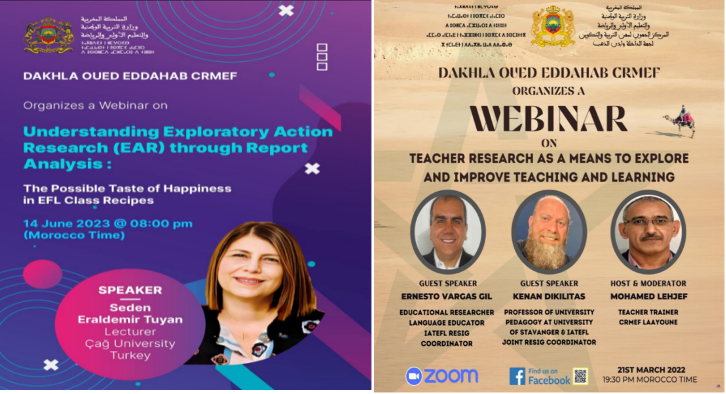
Some of the webinars with international experts
Why EAR in Preservice Teacher Education?
Introducing EAR was motivated by the need to help trainees reflect on their teaching so as to improve their practice and students’ learning. Many entered the programme with the belief that research belonged mainly to academia. As most held a three-year university degree, they tended to associate research with extensive reading, complex data analysis, and fixed results. Through EAR, I tried to demystify and deconstruct these perceptions of research as something burdensome and show trainees that teacher research begins with questions, puzzles, success stories, and challenges they encounter in their classrooms.
My interest in EAR developed through my engagement with Richard Smith’s webinars and publications, as well as his work with teachers in Chile, India, and Nepal. His definition of teacher research as “practitioner research… carried out by and for teachers, for their own benefit and that of their students” (Smith, 2020) helped shape the way I delivered the EAR module and how I mentored teachers to conduct their EAR projects.
EAR and EAR-Mentoring Frameworks
The structure of the module drew on Richard Smith’s works:
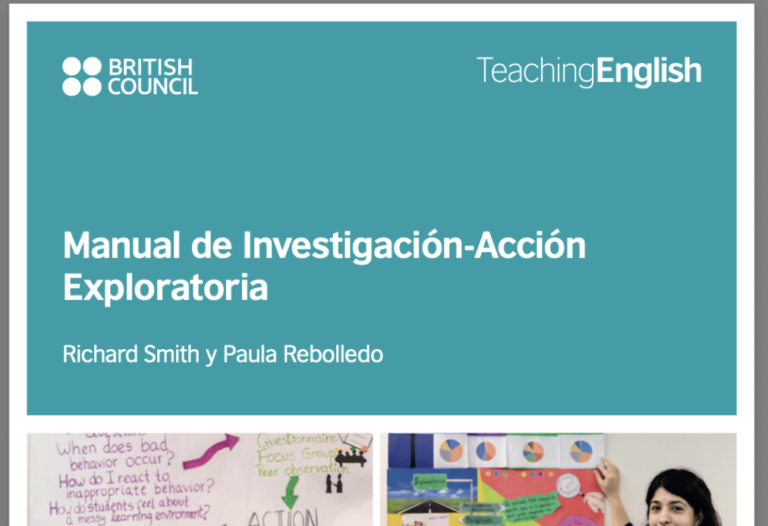
• A Handbook for Exploratory Action Research (Smith & Rebolledo, 2018), emphasising exploration before plunging into action.
• Mentoring Teachers to Research Their Classrooms (Smith, 2020), highlighting mentoring and teacher agency.
These frameworks align well with Moroccan classrooms, where trainees observe challenges during practicum such as large class sizes, classroom management, learner engagement, students using L1, adapting materials, and assessment issues. These issues become starting points for their EAR projects.
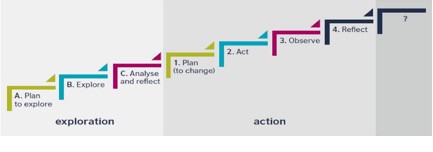
Steps of exploratory action research from Smith & Rebolledo (2018, p. 25)
EAR in Practice
The following are examples of the variety of topics that were researched in different high schools in Essmara, Boujdour and Tarfaya.
a. Reluctance to Speak Among First-Year Baccalaureate Students in Wadi Sakia Elhamra High School (Sabra Kaabich)
b. The Effect of Project Work on Ali Ibn Abi Talib Common Core Scientific Stream Students’ Communication Skills (Najib Abghough)
c. Developing Students’ Speaking Skills Through a School Club at Ennasr High School in Boujdour (Fatima Zahra Jawhar)
Teacher trainees
Sabra Kaabich explains her puzzle in this way:
“Every teacher enjoys teaching in a class where there is a good learning environment full of positive interaction and a good rapport with learners. As a teacher of English, I want to develop my students’ communication skills through involving them in several interactive activities. However, most of the students seem uninterested and they hesitate to speak in English, especially when I ask them to get involved in a speaking activity during the production stage of each lesson.
This problem needs more focus and investigation through an exploratory action research that will help me as an EFL teacher to discover the reasons behind the reluctance of the students to get involved in speaking activities, the causes that hinder positive interaction in the classroom, and what I need to do to solve this problem.”
Sabra’s EAR gained international recognition when she presented at the IATEFL Research SIG’s Teachers Research! Online 2021 Conference (10–11 December), sharing her EAR poster with a global audience.
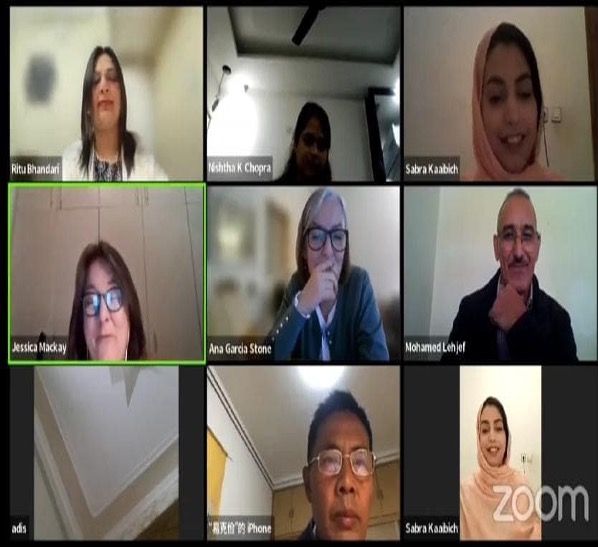
Sabra Kaabich presenting her EAR project at the IATEFL Research SIG’s Teachers Research! 2021
and her poster below
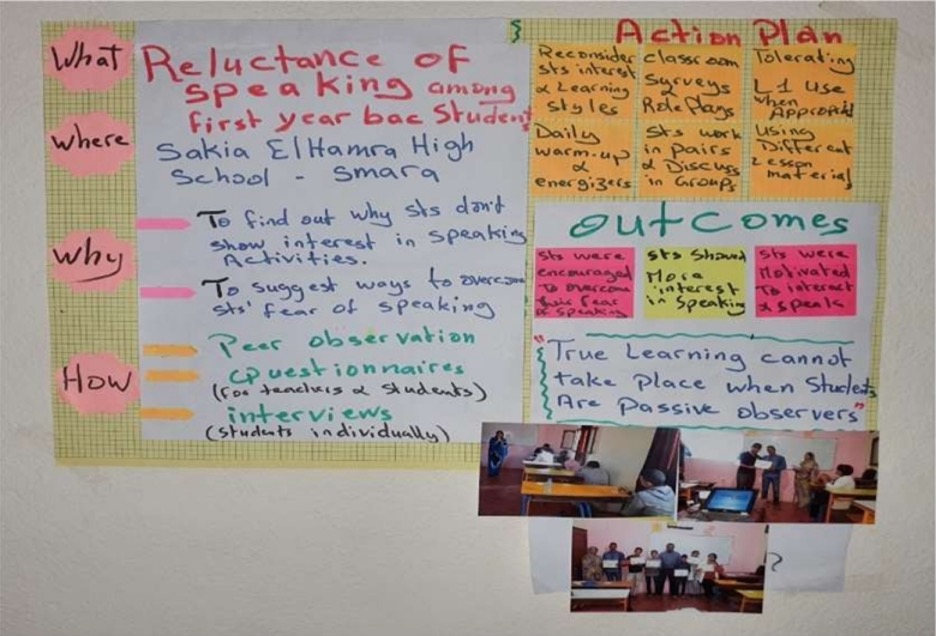
Mentorship as Demonstrated in Sabra’s Story
In the exploration phase, Sabra identified her puzzle, which was that many of her first-year Baccalaureate students were reluctant to participate in speaking activities and hesitated to communicate in English during classroom interactions. To investigate this issue, she conducted peer observations, administered questionnaires to both students and teachers, and held informal discussions with students. After analysing the data, she found that students’ reluctance originated mainly from limited vocabulary, lack of confidence, fear of making mistakes, pronunciation difficulties, shyness, and anxiety when speaking in front of their peers.
Based on this evidence, Sabra moved to action for change by designing and implementing a range of interventions aimed at increasing students’ participation and confidence in speaking English. Her action plan included daily warm-ups and icebreakers, pre-teaching vocabulary, using a variety of learning materials beyond the textbook, promoting pair and group work and integrating role plays in her teaching. These activities provided students with meaningful opportunities to communicate, collaborate, and express themselves in a supportive learning environment.
My mentoring of Sabra began by helping her identify a topic that is ‘MUSE’ (manageable, urgent, significant and engaging) (Smith & Rebolledo, 2018). Through active listening and reflective dialogue, I supported her in narrowing her research focus and developing a realistic action plan. As her project progressed, I provided feedback on her work, recommended relevant readings, and assisted her in designing research tools and classroom interventions. I adopted the role of a “guide on the side” rather than a “sage on the stage,” encouraging her to take ownership of the inquiry process and develop confidence in navigating the different stages of her EAR project.
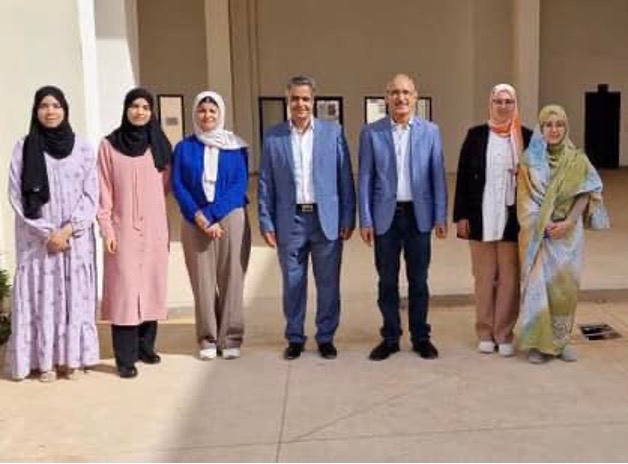
A shot with novice teachers of English after presenting their EAR projects.
I also mentored preservice teachers, school administrator trainees, and support staff as they conducted their EAR projects after completing the module. Most mentoring takes place face-to-face at the training centre but I also visited trainees who worked in neighbouring towns, mainly Tarfaya, Boujdour, and Essmara. We maintained regular communication through email, phone calls, and WhatsApp groups. I helped trainees design an EAR plan with flexible timelines for each stage. I also used questioning techniques to find out the tools they will use to collect data and how they will analyse it. I stressed triangulating data to see the issue they are researching from different angles, and reminded them that since EAR is small-scale research, they should not collect a lot of data. I also provided the trainees with a checklist to self-evaluate their research and to keep on track while exploring their issue.
This mentoring experience reinforced several important lessons about supporting trainees in Exploratory Action Research (EAR). First, effective questioning and active listening techniques are essential in helping trainees take ownership of their research, strengthen their voice and choice, and develop their agency as reflective practitioners. Second, trainees often propose broad research topics; therefore, mentors play a key role in helping them narrow and refine their focus. Another lesson is the value of collaboration during the research process. Trainees benefit from involving students as active participants in the exploration phase and from inviting colleagues to observe lessons and provide feedback, creating a culture of professional learning. I also learned the importance of establishing clear timelines and SMART objectives so that trainees can monitor their progress and remain focused on their goals. Furthermore, guiding trainees to collect only relevant and necessary data helps them avoid becoming overwhelmed and ensures that the research remains manageable. Finally, supporting trainees in designing innovative actions for change enhances the quality of both their professional learning and their research outcomes.
Conclusion
Implementing the EAR module at CRMEF Laayoune and Dakhla showed me that preservice teachers, school administrators and support staff can all benefit from studying the module and from mentorship while conducting their EAR. Mentoring helped practitioner trainees approach research with open-mindedness and responsibility.
Grounded in Smith’s frameworks and strengthened by mentoring and international engagement with guest speakers, the module helped improve teacher and administrator trainees’ ability to explore and act on issues relevant to them in a systematic way.
References
Burns, A. (2010). Doing Action Research in English Language Teaching. Routledge.
Calhoun, E. (1994). How to Use Action Research in the Self-Renewing School. ASCD.
Kemmis, S., & McTaggart, R. (1988). The Action Research Planner. Deakin University Press.
Smith, R. & Rebolledo, P. (2018). A Handbook for Exploratory Action Research. British Council.
Smith, R. (2020). Mentoring Teachers to Research Their Classrooms. British Council.
About the Author(s)
Mohamed Lehjef
Mohamed Lehjef is an English language educator and teacher trainer at the Regional Center for Education and Training Professions (CRMEF) in Laayoune, Morocco. He previously served as President of Laayoune local branch of the Moroccan Association of Teachers of English (MATE). His work focuses on teacher education, action research, integrated school projects and educational leadership.

What an excellent piece of writing! It is just as interesting as the process itself. I found the way Mohamed describes the EAR process engaging and easy to follow, and was especially happy to learn that he has been working across disciplines and with school staff as well. Sabra’s story is a gem, and Mohamed shows us how to put our mentees centre-stage, while still providing information on the role the mentor plays. The illustrations and the photos make this short piece of writing visually satisfying, too. My takeaway is that teacher educators like Mohamed are able to influence not just their mentees’ educational progression, but can also contribute to education reform, whereby, in his context, pre-service teachers meet the joys and challenges of classroom research as early as their first year of training. I don’t know where the expressions that he aims to be a “guide on the side” rather than a “sage on the stage,” have come from, but it encapsulates the approach many of us are doing our best to follow in this community.
Interesting indeed. This what we have beed seeking. A teacher who is engaged in EAR without being asked to do that. Sharing the results of EAR also is an area that needs highlights. Many thanks Mr Lehjef for that very inspiring article.
Fantastic work, Mohamed. Congratulations!