What does teacher professional development imply? There are different ways to continue learning in our profession such as attending conferences, seminars, or reading the latest methodology books. But what if the most powerful sources for learning are in your classroom(s): your students, your practice, the materials?
That was precisely the question at the heart of the Teacher-Research for Professional Development workshop series, which ran as part of the MenTRnet 2025 programme supported by the IATEFL ReSIG, and which we (Rubén Mazzei and Mariana Serra) had the privilege of leading together.
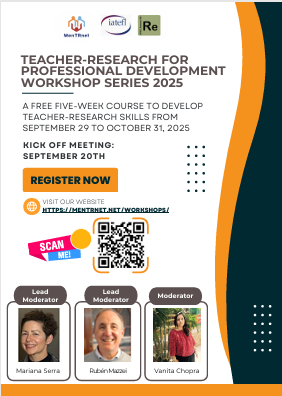
The workshop was designed with one central aim: to support teachers in seeing research not as something done about them or for them by academics, but as something they can do themselves, from within their own professional lives. Teacher-research – sometimes called classroom-based research or teacher inquiry – is a powerful framework for professional development because it starts with teachers’ questions about their own practices, their learners and their contexts. The workshop was open to teachers from all around the world, regardless of prior experience with this type of research.
A week before the workshop began, participants were invited to do some While Waiting Warm-up Activities which comprised preparatory readings and video viewings designed to guide participant teachers to the main workshop topic (teacher-research) so they could begin to get a sense of what teacher-research is. The workshop started on 29th September and it unfolded across five carefully structured weeks, each mirroring the stages of the research process:
- Week 1 offered an introduction to teacher-research and why it matters.
- Week 2 guided participants through identifying a focus for their teacher-research projects and crafting research questions from their own professional curiosity.
- Week 3 explored practical tools for exploratory action research.
- Week 4 focused on analysing and interpreting data. We were particularly honoured this week to welcome Kenan Dikilitas as a guest speaker, whose talk on analysing and interpreting data brought both clarity and inspiration.
- Week 5 brought everything together around sharing research outcomes – because research only truly completes its cycle when it reaches others.
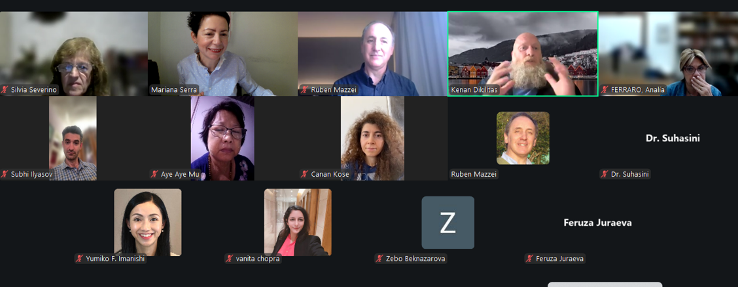
Sessions were deliberately practical in nature with a meeting over Zoom every Saturday integrated with a virtual space on the Canva platform. Participants didn’t just learn about research; they worked through each stage, reflecting on both the process, the implementation, and their own evolving identity as teacher-researchers.
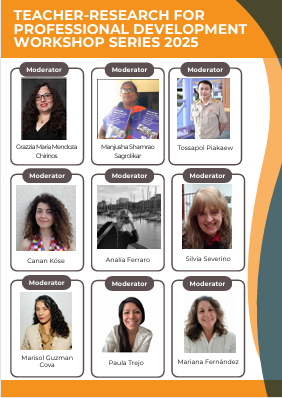
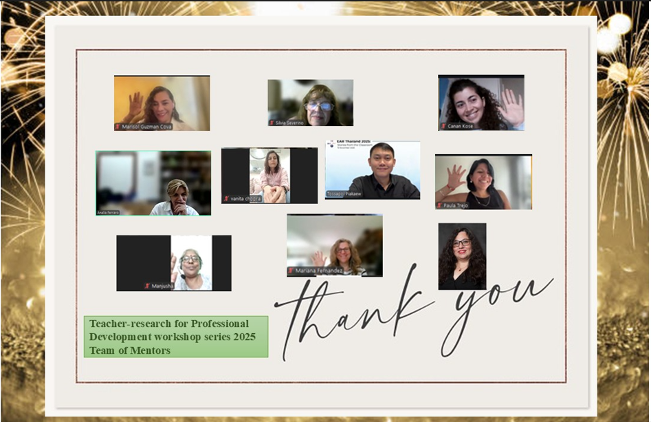
None of this would have been possible without the workshop’s dedicated mentoring team. Alongside ourselves (Mariana and Ruben) as lead mentors, seven mentors all active in teacher-research (Vanita Chopra, Silvia Severino, Canan Köse, Manjusha Shamrao Sagrolikar, Paula Trejo, Analía Ferraro, and Marisol Guzmán Cova) each accompanied a small group of participants throughout the five weeks. Their role was to guide participants through attentive listening, insightful questions, and encouragement, and the mentor-mentee relationships provided a clear path to consistent human connection despite the distance online workshops involve.
The session objectives were ambitious but achievable. By the end of the programme, participants understood research as a genuine pathway to professional development; developed the autonomy and agency to pursue it independently; implemented a small-scale research project in their own classrooms or institutions; reflected meaningfully on their findings; and shared those findings within our community of online practice, and where possible, beyond.
That “beyond” became a reality as several participants went on to present their research at the IATEFL Teachers Research! Online Conference in March 2026. This was a wonderful outcome that speaks to what teachers can achieve when given the right support and space to inquire and is also evidence of the quality and commitment of the participants.
We share below some of the project titles of the workshop participants who presented at this conference to give the you a sense of the workshop outcomes.
Mariana Cordero (Argentina) Visual & Digital Materials for Engagement: An Action‑Research Study of Adult Multi‑Level ESOL Learners.
Paula Suparo (Argentina) Testing and Refining AI Prompts for Literature-Based English Lessons.
Khantanaly Panvilaysone (Laos) Using online games (Wordshake From Learning English) to enhance vocabulary through motivation, meaningful context, interaction, and repeated, engaging language use.
Subhi Ilyasov (Azerbaijan) How clear are my instructions?
Aye Aye Mu (Myanmar) A Reflection on Some Applicable Professional Strategies for Bilingual Teachers in Myanmar.
Barbara Galvan (Argentina) Designing Effective AI Prompts for Literature-Based Activities in Primary EFL Classes
Yumiko Fujita Imanishi (Japan) Exploring Student Voice and English Language Motivation in an EFL Context through Exploratory Action Research.
Mentors and participants express their gratitude for having been part of our community as you can see in the following quotations:
‘Hi Ruben and Mariana, you two are great supporters. When I listen to you both, I really feel relaxed. Thank you very much for your help. I was exhausted while presenting, but anyway I managed to present…’. (Subhi Ilyasov, workshop participant and presenter)
‘Thank you very much for supporting our EAR and giving us such a wonderful opportunity to give a presentation!’ (Yumiko Fujita Imanishi, workshop participant and presenter)
‘…I am grateful for the guidance, inspiration, and sense of belonging that this initiative has fostered. It has been a privilege to contribute and to witness the collective commitment to advancing teacher-research.’ (Analía Ferraro, mentor)
‘Thank you so much dear Mariana and Ruben! Thank you dear team! It’s always a pleasure to work, learn and share with you every challenge this inspiring workshop offers every year!’ (Silvia Severino, mentor)
‘…Many thanks for the opportunity to collaborate in this Teacher-research for professional development 2025. It was a great pleasure to be part of this lovely group and learn from all of you.’ (Marisol Guzman Cova, mentor)
Conclusion
This workshop series is an invitation to teachers to explore and research their own classrooms and their students´ learning, and to develop teacher agency. It is also a safe space to share multicultural identities by having opportunities for reflection, dialogue, collaboration, and culturally responsive practice and to network with other teachers, building an international professional learning community.
For the 2026 edition of the workshop series (September-October), we have planned pre-workshop activities that will strengthen bonds among colleagues from all regions of the world. Join us this year! Soon, you’ll be able to find registration information on this site and in our social media accounts: Teacher-Research for Professional Development Facebook group and/or the Teachers Research! Facebook group, Instagram (@marianaserra2 and @rubenmazzei) and LinkedIn (https://www.linkedin.com/company/mentrnet/)
We would like to express our heartfelt thanks to Professor Richard Smith for his invaluable support and helpful guidance through the years for our workshop series. We would also like to thank the IATEFL Research SIG and MenTRnet committee and members for their support.
About the Author(s)
Mariana Serra
Mariana Serra is a teacher and a licentiate in English working at the University of Buenos Aires (UBA). She has co-moderated international workshops on Teacher-Research since 2020 and the Mentoring Teacher-Research sessions twice. She helped to develop the Enhancement mentoring for teacher-research: A positive approach in a crisis (2021), co-wrote Mentoring Presence for Supporting International Teacher-Researchers (2022) and co-edited Stories of Mentoring Teacher-Research (2024). She is now part of Project Erasmus (UBA- Çağ Üniversitesi).

Ruben Mazzei
Rubén Mazzei is a professor of English language and literature. He was coordinator of the CPD department (Ministry of Education, Province of Buenos Aires) for eight years. He is also part of MenTRnet (Mentoring Teacher Research network) for which he facilitates the international Teacher-Research for Professional Development workshop. He has published book chapters on Teacher-Research and Mentoring. He coordinates the Legitimation Code Theory group in Argentina.