
How can teacher educators support meaningful, evidence-based reflection among pre-service teachers, especially in times of uncertainty, in a country impacted by conflicts, disasters, emergencies and wars? This post explains the Mentoring for Exploratory Action Research for Teacher-Educators in Ukraine project that we believe can serve as an example of successful international support for an education system in a country that has been in a war since 2022.
The initial idea for this project came from various meetings with colleagues from all over the world. First, Ukrainian teacher-educators – active members of the Professional Association of English Language Teachers-Ukraine – often discussed ways to improve the training of future teachers, especially in the circumstances impacted by war. During these discussions, I often brought up as a possible solution my own experience of exploratory action research in the Department of Applied Linguistics at the University of Warwick – a place where the Mentoring for Exploratory Action Research program is being implemented by Professor Richard Smith and his team. Then, when attending IAETFL Research SIG events during the IATEFL Conference 2025 I met mentors from MenTRnet and learnt about the various projects of mentoring teacher-research in Uzbekistan, Turkey, Thailand, India and Nepal. It inspired me to think about starting a similar project for the Ukrainian context and, together with Richard Smith, I reached out to experienced teacher-research mentors Elyanora Menglieva and Sirin Soyoz from the MenTRnet community. As a result we developed a two-phase program for Ukrainian teachers of pedagogical universities.
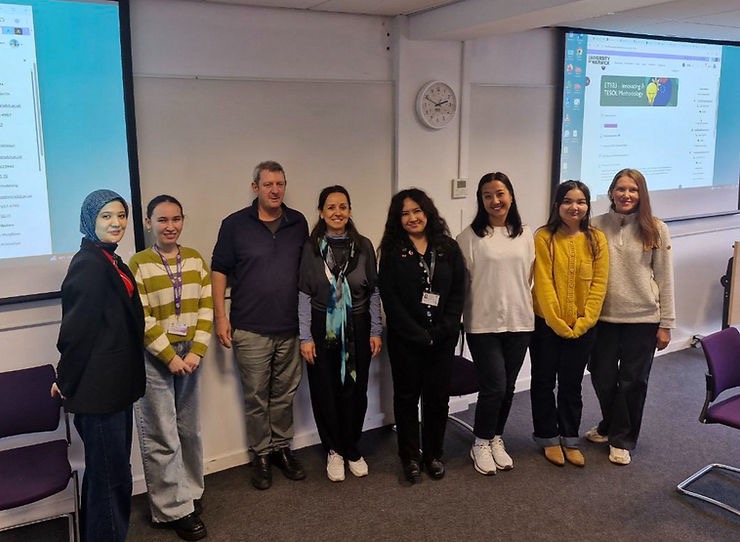
Project presentation to MA TESOL students at the University of Warwick. Center: Richard Smith, Natalia Krynska, Elyanora Menglieva
The Mentoring Teacher Educators for Exploratory Action Research project is designed to address the challenges teacher educators at pedagogical universities in Ukraine face and it aims to improve their teaching, firstly by developing skills to explore teacher educators’ own practices, choose research methods and tools, plan changes, and evaluate their effectiveness.
Running for eight months, the programme follows two phases. The first phase included Exploratory Action Research webinars, interactive group discussion sessions, and mentoring support. From September 2025 to January 2026, project participants (14 teacher educators) explored lessons, student opinions, and their own ideas about teaching, equipped by EAR as a research technique.
A distinctive feature of this phase was the use of community listening sessions. In these sessions, we invited participants to reflect openly on each stage of their experiences with EAR: what surprised them, what they noticed about their students or themselves, and how the process has shaped their understanding of teaching and learning. Participants shared that after research they reconsidered their own beliefs. For example, one participant said: “I thought that group activities are something students enjoy, but research shows that students feel intimidated and overwhelmed when asked to work in a group. They are a generation of online learning and just not ready for offline yet”. Other teacher educators looked at the methods from new perspectives:“We used to teach reading for the sake of language development, but is this the right approach for reading fiction literature?”
When asked about their experience of being mentored for EAR, most participants appreciated mentoring support. One said: “Research can easily become overwhelming. Our mentor helped us maintain a clear focus, preventing us from getting lost in such a vast field”. Another person said: “EAR is a reflective process that can feel isolating; a mentor provides the necessary objectivity and structure. The guidance they provide ensures the research stays manageable and doesn’t get lost in ‘theory-heavy’ rabbit holes.”
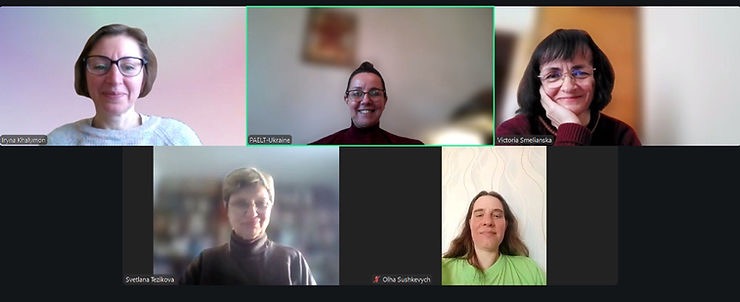
Project session: Iryna Khalimon, Natalia Krynska, Victoria Smilyanska, Svitlana Tezikova, Olga Sushkevych
With the first phase now completed, participants have developed a strong foundation as teacher-researchers. Four joint and two individual projects were presented at a special MenTRnet-supported “Exploratory action research in Ukraine Showcase 2026” – an international online event showcasing these students. Participants are from three pedagogical universities in Ukraine – each of which has its own educational context, its own student population, and unique problems, which the research was dedicated to solve. The results of the research can be found on our project website: Mentoring Teacher Educators for Exploratory Action Research
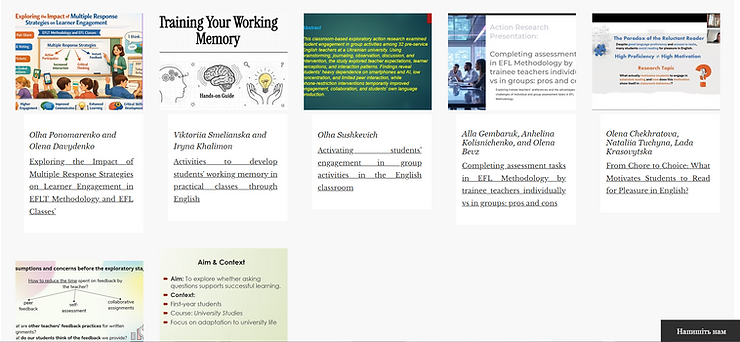
Exploratory action research in Ukraine Showcase 2026 – Conference materials
Phase two of the program is training participants to be mentors. We hope that, despite the difficult situation, stress, and fatigue caused by the ongoing war, Ukrainian teacher educators will be able to participate in training on developing mentoring skills for Exploratory Action Research from March to May 2026. This training is enabling participants – teacher educators of pedagogical universities – to support pre-service teachers and colleagues in conducting their own research using the Exploratory Action Research methodology. Importantly, participants will also have opportunities to share their insights and reflect on their EAR journeys at MenTRnet events, contributing their voices and experiences to an international audience.
Beyond responding to the immediate challenges facing Ukrainian teacher education, the project seeks to nurture sustainable professional communities grounded in collaboration, inquiry, and mutual support. Through ongoing dialogue and shared practice, we hope participants will strengthen their capacity for autonomous development while remaining connected to wider international networks. Partnership with colleagues from the UK and the broader community of mentors is not only a source of professional exchange, but also a space of collegial learning built on respect and reciprocity.
About the Author(s)

Nataliia Krynska
Nataliia Krynska is a teacher educator, ESOL/EAP specialist, and project manager with the Professional Association of English Language Teachers in Ukraine (https://www.paelt-ukraine.com) She leads national and international initiatives in mentoring, professional development, and digital innovation, supporting reflective, evidence-based practice in English language teaching.


I am completely blown away by the dedication and resilience of all those participating in this project. What could be more challenging than working in a war stricken country? Yet, it is exactly in such conditions when educators need to hold up the hope that life and schools will return to normal, and till then, learning and teaching will go on owing to the steely determination of these brave Ukrainian educators. Credit also goes to those who set up and are running this program at Warwick Uni. Instead of hand wringing, Richard Smith and his team do what they know best: supporting teachers under difficult circumstances by providing professional guidance and enhancing their teacher-researcher mentees’ development..