Below are some opportunities / benefits for members of MenTRnet in connection with writing and publishing (to join MenTRnet, go to our home page and click on the button in the top right hand corner: https://mentrnet.net/)
As mentors (to write about mentoring)
The MenTRnet website has a page dedicated to short articles and posts that we call ‘Features’. These are written by MenTRnet members, specifically for the MenTRnet website. Writing a Feature can be a good first step in writing for publication (as can writing a Book Review – see below) because the articles are generally much shorter than a journal publication. They are not ‘academic’ pieces of writing and we ask for no more than five references, all of which should be open access. There is a quicker turnaround than with an academic journal, and we try to publish everything within a month or two of acceptance. We have a review process and we will work with you to help you make your draft as good as it can be.
There are many different areas in relation to mentoring teacher-research that you could write about. Here are some ideas to get you started:
- You could write your own story of mentoring teacher-research – this could be individual or collaborative.
- Write a summary of a workshop, a MenTRnet monthly session, a conference presentation you have given, a regional or national TR movement …
- Conduct an interview with a mentor or mentors of teacher-researchers and write that up for the Feature page.
- Any topics or issues related to mentoring teacher-research e.g. exploring critical issues in TR (gender, social justice, multilingualism/translanguaging, sustainability ….)
- Any other creative ideas – e.g. visual/interactive posts
- News items about mentoring teacher-research (e.g. translation of mentoring handbook to Japanese)
For further inspiration, look at the Features we have published so far to get an idea of the breadth of topics we have covered.
If you have an idea for a Feature you would like to write, then please email Susan Dawson, who edits the Features page: [email protected] or [email protected] She will send you the guidelines so that you can begin writing your post.
2. Teacher association newsletters and practice-oriented journals
MenTRnet enjoys a special relationship with IATEFL Research SIG, and the SIG’s yearly publication ELT Research has included reports of teacher-research mentoring in the past. Here are the guidelines for prospective authors. Teacher-research mentoring activities have also often been reported by MenTRnet members in The Pilgrims Teacher Trainer Journal, and you can consult the editor, Phil Dexter, for further information about how to contribute. Other practice-oriented newsletters and journals you might consider for reports of your mentoring practice are, for example Voices, ELTED Journal, Humanising Language Teaching, Modern English Teacher and ELT Journal
3. Book review writing opportunities
The writing of book reviews offers an excellent opportunity for budding authors to write a short piece on a publication that is related to MenTRnet’s main focus, namely, teacher-research. Such opportunities are regularly announced in our main email discussion list (if you become a member of MenTRnet). Over the past few years, MenTRnet members and their teacher-researcher mentees have successfully published reviews in a number of journals – mainly in those listed above, as well as in ELT Classroom Research Journal (see below).
Since MenTRnet has a particular focus on catering for ELT practitioners in Global South contexts, we are now following a “double open access policy”, which means that we solicit reviews on Open Access books that are then published in Open Access journals, such as ELTED or ELTCRJ (see above and below). The book review writing process is supported by more experienced review writers in MenTRnet. As a result of mentoring writing before submission, we have achieved exceptionally high acceptance rates. We encourage all our members to be on the lookout for opportunities to try their hand at this genre.
If you are interested in writing a book review, respond to invitations from Eli Békés in the MenTRnet discussion list or email her for further guidance: [email protected]
For reports of teachers’ research:
1. English Language Teaching Classroom Research Journal (ELTCRJ)
This journal (https://eltcrj.com/) is a recently founded “teacherly” journal with which we have developed strong links, and one that focuses on publishing teacher-researcher accounts and reports. This biannual publication (appearing in May and November) is also a “mentoring journal”, which aims at guiding prospective authors by providing supportive editorial and peer review feedback. Apart from that support, members of our community in MenTRnet have also been actively facilitating the writing up of articles for ELTCRJ. That work, prior to submission, is mainly carried out by a six-member Publishing Team led by Sidney Martin, [email protected] but often other experienced MenTRnet members also act as writing mentors. So, if a MenTRnet member would like to write an article on their own classroom research or co-author a piece with their teacher-research mentees for ELTCRJ, they can get in touch with the team via Sidney.
Previous issues of ELTCRJ are available here: https://eltcrj.com/archive/
2. MenTRnet / ReSIG Event Proceedings (video) and PPP (Presentations to Publication Project)
The Proceedings of the Teachers Research! Online conferences as well as the Presentations to Publication Project (PPP) support practitioner research in ELT from initial dissemination to formal publication. The proceedings offer a video record of conference presentations, extending their impact beyond the live event. The PPP then offers structured mentoring to presenters so that they can turn their conference contributions into publishable articles by providing targeted support in academic writing, revision, and feedback.
Thus, the Proceedings–PPP pipeline fosters reflective practice and promotes reporting of classroom-based research by and for teachers.
This project is run by our Publishing Team with its lead coordinator, Sidney Martin (see his email above), and five other coordinators: Simona Macenaite, Azadeh Moladoost, Ella Maksakova, Lidia Casalini and Eli Békés.
3. Self-publishing
Here are some ideas from Mentoring Teachers to Research Their Classrooms: A Practical Handbook (Smith, 2020, p. 69):
“Due to their primarily local relevance, it can be difficult to find a national or international publisher for teacher-research write-ups, but you and your teachers can investigate possibilities for self-publishing online. For example, you could:
• make a website for your group’s reports using a free platform like WordPress.com or weebly.com
• link such a site to video recordings of oral presentations which you have uploaded to YouTube
• upload photographs of posters and written reports
• publicise the website via social media.”
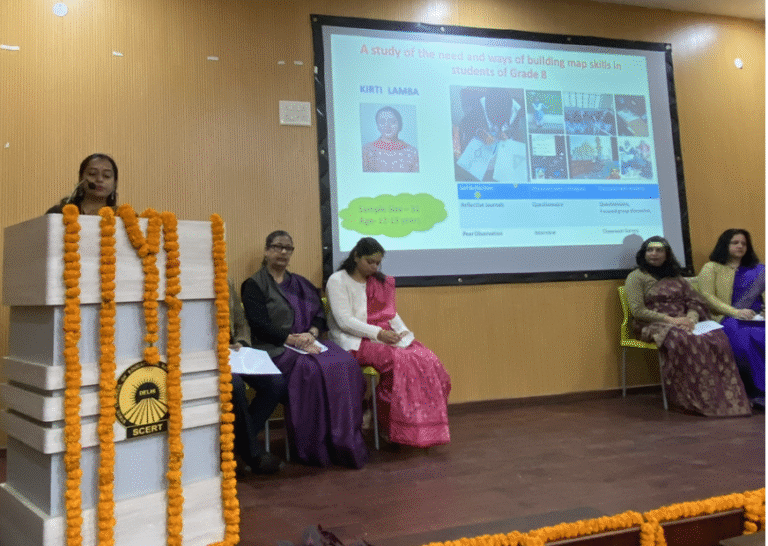
One example of such a website is here. Two examples of mentors finding local publishing opportunities for written teacher-research reports which were then publicised more widely are here (India) and here (Nepal).
You could combine doing the above with writing a Feature about it for the MenTRnet website as mentor, highlighting your own and your teachers’ experiences – MenTRnet will then publicise this for you.
Finally, here is an article which discusses alternative formats for sharing teacher-research: Smith, R., Bullock, D., Rebolledo, P. and Robles López, A. 2016 .‘By teachers for teachers: innovative, teacher-friendly publishing of practitioner research’. English Language Teacher Education and Development (ELTED) Journal 20: 116–125.